
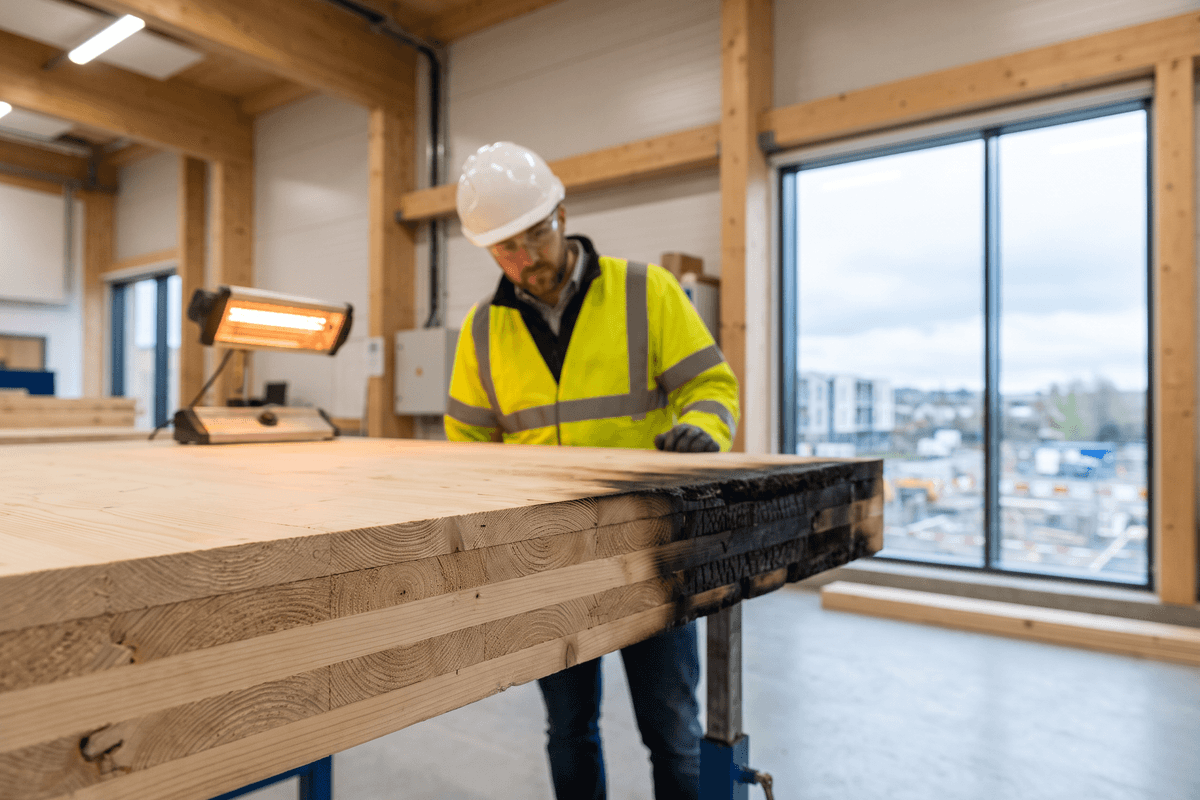



For the past five years, the UK construction sector has found itself caught in a high-stakes structural paradox. On one side stands the urgent imperative to decarbonise the built environment, driving architects, developers, and local authorities toward mass timber, cross-laminated timber (CLT), and glulam as low-embodied-carbon structural saviours. On the other sits a wall of regulatory conservatism, insurer risk aversion, and post-Grenfell scrutiny that has left many ambitious commercial timber schemes dead in the water at pre-construction stages.
That deadlock, however, is finally beginning to crack under the weight of hard empirical science. The news that the Fire Protection Association (FPA) has been shortlisted for a 2026 London Construction Award for its research advancing sprinkler systems and fire protection in mass timber construction highlights a transformative shift: the industry is replacing theoretical debate with rigorous, full-scale testing.
The Insurance Impasse: Why Mass Timber Stalled
To understand the profound significance of this research, one must examine the operational landscape faced by Tier-1 contractors and structural engineers navigating the UK market today. While European neighbours such as France, Austria, and Sweden have embraced multi-storey timber framing, the UK commercial sector has faced acute resistance from insurers and warranty providers.
The core issue has rarely been whether mass timber can achieve standard fire-resistance ratings (such as REI 60, 90, or 120 minutes) in standard furnace tests. Large-section timber chars at a predictable rate of roughly 0.65 mm/min, forming a protective carbonaceous layer that insulates the unburnt structural core. Instead, commercial underwriters, loss adjusters, and the Fire and Rescue Services have consistently raised deeper operational concerns:
- Self-Sustained Smouldering and Delamination: The risk that char fall-off in early-generation adhesive CLT could expose fresh timber layers to oxygen, leading to secondary flashover or prolonged burning after the primary compartment fire subsides.
- Active Suppression Interaction: A historical lack of large-scale test data on how automatic water sprinkler systems perform inside exposed timber compartments where structural elements themselves contribute to the fuel load.
- Property Loss vs. Life Safety: While Approved Document B prioritises safe evacuation (life safety), property insurers are primarily concerned with asset preservation, business interruption, and the total cost of water damage combined with structural repair.
"Without robust, repeatable testing data that demonstrates how active suppression controls fire spread and prevents structural involvement in mass timber, underwriters will continue to demand costly over-engineering or outright structural encapsulation."
The FPA Breakthrough: Bridging Active Suppression and Combustible Structures
The research conducted by the Fire Protection Association at its Gloucestershire-based laboratory tackles these challenges head-on. By executing rigorous, large-scale compartment tests, the FPA has provided the definitive baseline data needed to calibrate sprinkler system design specifically for engineered timber buildings.
1. Calibrating Sprinkler Densities and Actuation
Standard commercial sprinkler design criteria (such as BS EN 12845) were historically developed around non-combustible building envelopes containing variable combustible contents. The FPA’s research provides the empirical evidence required to establish whether standard residential and commercial design discharge densities are sufficient to suppress fires in compartments featuring varying percentages of exposed CLT ceilings and walls, or whether enhanced water flow rates and faster response sprinkler heads are required.
2. Mitigating Fire Regrowth and Charring
One of the critical findings of active suppression research in mass timber is the role of rapid suppression in preventing structural charring from reaching critical depths. When sprinklers actuate during the incipient or early growth phase, they knock down flame temperatures before the timber's auto-ignition threshold is reached, drastically limiting char formation and eliminating the risk of adhesive delamination.
3. Water Management and Post-Fire Resilience
A major commercial hurdle for timber construction has been the fear that sprinkler actuation will cause irreversible moisture damage to hygroscopic structural timber. Empirical testing provides clear operational insights into water drainage pathways, structural drying kinetics, and non-destructive remediation protocols, providing insurers with a realistic assessment of post-incident asset recovery.
Comparing Fire Safety Approaches in UK Mass Timber Delivery
As main contractors and specialist sub-contractors navigate client sustainability demands alongside Building Safety Act Gateway 2 submissions, selecting the correct fire mitigation strategy is essential.
| Design Strategy | Key Mechanisms | Impact on Net Zero & Aesthetics | Underwriting & Gateway Approval |
|---|---|---|---|
| Total Encapsulation | Multiple layers of Type F gypsum plasterboard or non-combustible cladding fully shielding structural timber. | High embodied carbon penalty; completely hides natural timber surfaces; increases floor-to-floor heights. | Easiest path through standard insurer guidelines, but compromises the primary architectural rationale for timber. |
| Sacrificial Charring (Passive Only) | Oversizing timber sections to accommodate calculated char depths without structural collapse. | Maximises biophilic timber exposure; zero plasterboard waste; higher structural volume required. | Faces severe resistance from UK insurers over smouldering risks and extended fire decay phases. |
| Engineered Hybrid (Active + Tested Passive) | Optimised sprinkler suppression (validated via FPA data), high-performance adhesives, and targeted cavity barrier protection. | Balances exposed architectural timber with strategic encapsulation; optimal carbon and spatial efficiency. | Rapidly becoming the gold standard for Building Safety Regulator and commercial underwriter sign-off. |
Practical Guidance for Site Managers, Engineers, and Trades
For UK construction professionals, fire safety in mass timber cannot be treated as an academic exercise reserved for fire engineers. It dictates day-to-day site practices, detailing, and quality assurance under the Golden Thread regime.
Rigorous Penetration Sealing and Cavity Barriers
Fire compartmentation in mass timber structures is uniquely sensitive to installation defects. Where MEP services penetrate CLT slabs or glulam beams, proprietary intumescent collars and fire batts must be tested specifically for timber substrates. Standard details tested on masonry or aerated concrete cannot simply be substituted onto timber walls, as differential movement and thermal expansion behave differently under fire exposure.
Managing Site-Phase Moisture and Fire Risks
The construction phase remains the period of highest vulnerability for timber structures before active suppression systems are commissioned. Site managers must implement stringent hot-work permitting, early temporary roof enclosures, and breathable weather membranes to prevent moisture entrapment that could compromise timber integrity or fire treatment performance.
- Verify Adhesive Compatibility: Ensure specified CLT products use certified heat-resistant adhesives (e.g., PUR adhesives meeting EN 15425 test standards) to avoid delamination during elevated thermal exposure.
- Coordinate MEP Openings Early: Retrofit core-drilling into mass timber on site can breach fire barriers and compromise structural integrity. All openings must be BIM-coordinated and pre-cut during factory fabrication.
- Engage Insurers at Stage 2: Presenting empirical testing data (such as the FPA’s findings) during early concept design prevents costly redesigns or late-stage demands for total plasterboard encapsulation at Gateway 2.
Looking Ahead: From Fringe Alternative to Mainstream Delivery
The nomination of the Fire Protection Association at the 2026 London Construction Awards reflects an essential maturing of the UK construction supply chain. For years, the mass timber sector was marked by an adversarial divide between green building evangelists and fire safety traditionalists. That friction is now giving way to collaborative, data-driven engineering.
As the Building Safety Regulator tightens its oversight of higher-risk buildings and commercial developers face relentless pressure to meet Whole Life Carbon benchmarks, the path forward is clear: robust testing data is the foundation of modern construction. By validating the interaction between active sprinkler suppression and engineered timber, UK construction can build higher, greener, and above all, safer.